> ## Documentation Index
> Fetch the complete documentation index at: https://model-context-protocol.mintlify.site/llms.txt
> Use this file to discover all available pages before exploring further.
# 为服务器开发者
> 开始构建您自己的服务器,以便在 Claude for Desktop 和其他客户端中使用。
在本教程中,我们将构建一个简单的 MCP 天气服务器并将其连接到主机 Claude for Desktop。我们将从基本设置开始,然后逐步进行更复杂的用例。
### 我们将构建什么
许多 LLM(包括 Claude)目前无法获取天气预报和严重天气警报。让我们使用 MCP 来解决这个问题!
我们将构建一个暴露两个工具的服务器:`get-alerts` 和 `get-forecast`。然后我们将服务器连接到 MCP 主机(在本例中为 Claude for Desktop):
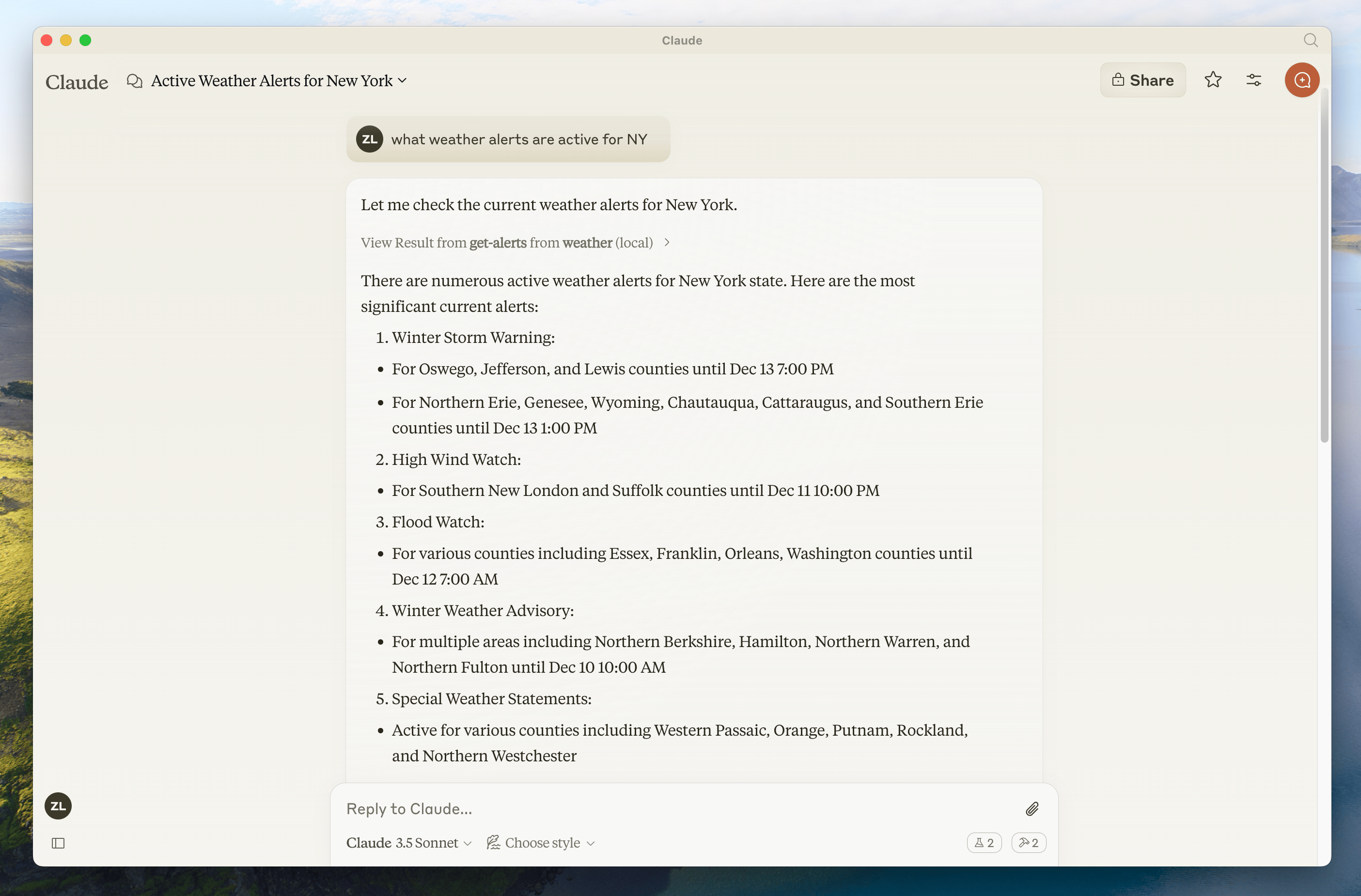
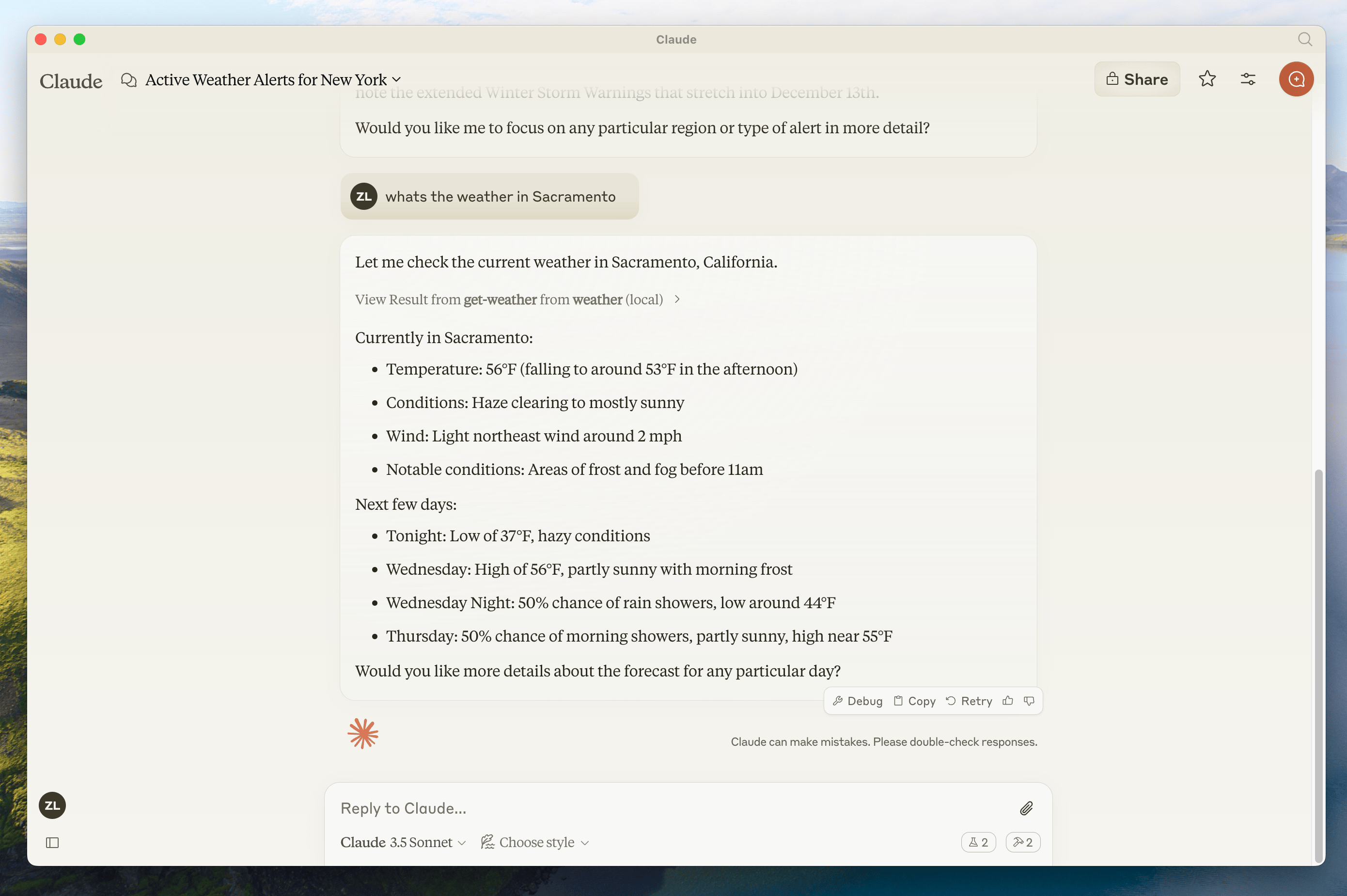 服务器可以连接到任何客户端。我们在这里选择了 Claude for Desktop 以简化操作,但我们也有关于[构建您自己的客户端](/quickstart/client)以及[其他客户端列表](/clients)的指南。
由于服务器是本地运行的,MCP 目前仅支持桌面主机。远程主机正在积极开发中。
### 核心 MCP 概念
MCP 服务器可以提供三种主要类型的功能:
1. **资源**:可以被客户端读取的类似文件的数据(如 API 响应或文件内容)
2. **工具**:可以由 LLM 调用的函数(需要用户批准)
3. **提示**:帮助用户完成特定任务的预编写模板
本教程将主要关注工具。
让我们开始构建我们的天气服务器吧
### 先决知识
本快速入门假设您熟悉:
* Python
* LLMs 如 Claude
### 系统要求
对于 Python,请确保您安装了 Python 3.9 或更高版本。
### 设置您的环境
首先,让我们安装 `uv` 并设置我们的 Python 项目和环境:
```bash MacOS/Linux theme={null}
curl -LsSf https://astral.sh/uv/install.sh | sh
```
```powershell Windows theme={null}
powershell -ExecutionPolicy ByPass -c "irm https://astral.sh/uv/install.ps1 | iex"
```
确保在此之后重新启动您的终端,以确保 `uv` 命令被识别。
现在,让我们创建并设置我们的项目:
```bash MacOS/Linux theme={null}
# 创建一个新目录用于我们的项目
uv init weather
cd weather
# 创建虚拟环境并激活它
uv venv
source .venv/bin/activate
# 安装依赖项
uv add mcp httpx
# 删除模板文件
rm hello.py
# 创建我们的文件
mkdir -p src/weather
touch src/weather/__init__.py
touch src/weather/server.py
```
```powershell Windows theme={null}
# 创建一个新目录用于我们的项目
uv init weather
cd weather
# 创建虚拟环境并激活它
uv venv
.venv\Scripts\activate
# 安装依赖项
uv add mcp httpx
# 清理样板代码
rm hello.py
# 创建我们的文件
md src
md src\weather
new-item src\weather\__init__.py
new-item src\weather\server.py
```
将此代码添加到 `pyproject.toml`:
```toml theme={null}
...rest of config
[build-system]
requires = [ "hatchling",]
build-backend = "hatchling.build"
[project.scripts]
weather = "weather:main"
```
将此代码添加到 `__init__.py`:
```python src/weather/__init__.py theme={null}
from . import server
import asyncio
def main():
"""包的主入口点。"""
asyncio.run(server.main())
# 可选地在包级别公开其他重要项目
__all__ = ['main', 'server']
```
现在让我们深入构建您的服务器。
## 构建您的服务器
### 导入包
将这些添加到 `server.py` 的顶部:
```python theme={null}
from typing import Any
import asyncio
import httpx
from mcp.server.models import InitializationOptions
import mcp.types as types
from mcp.server import NotificationOptions, Server
import mcp.server.stdio
```
### 设置实例
然后初始化服务器实例和 NWS API 的基本 URL:
```python theme={null}
NWS_API_BASE = "https://api.weather.gov"
USER_AGENT = "weather-app/1.0"
server = Server("weather")
```
### 实现工具列表
我们需要告诉客户端有哪些工具可用。`list_tools()` 装饰器注册此处理程序:
```python theme={null}
@server.list_tools()
async def handle_list_tools() -> list[types.Tool]:
"""
列出可用工具。
每个工具使用 JSON Schema 验证指定其参数。
"""
return [
types.Tool(
name="get-alerts",
description="获取某个州的天气警报",
inputSchema={
"type": "object",
"properties": {
"state": {
"type": "string",
"description": "两字母州代码(例如 CA,NY)",
},
},
"required": ["state"],
},
),
types.Tool(
name="get-forecast",
description="获取某个位置的天气预报",
inputSchema={
"type": "object",
"properties": {
"latitude": {
"type": "number",
"description": "位置的纬度",
},
"longitude": {
"type": "number",
"description": "位置的经度",
},
},
"required": ["latitude", "longitude"],
},
),
]
```
这定义了我们的两个工具:`get-alerts` 和 `get-forecast`。
### 辅助函数
接下来,让我们添加用于查询和格式化来自国家气象局 API 的数据的辅助函数:
```python theme={null}
async def make_nws_request(client: httpx.AsyncClient, url: str) -> dict[str, Any] | None:
"""向 NWS API 发出请求并进行适当的错误处理。"""
headers = {
"User-Agent": USER_AGENT,
"Accept": "application/geo+json"
}
try:
response = await client.get(url, headers=headers, timeout=30.0)
response.raise_for_status()
return response.json()
except Exception:
return None
def format_alert(feature: dict) -> str:
"""将警报功能格式化为简洁的字符串。"""
props = feature["properties"]
return (
f"事件: {props.get('event', '未知')}\n"
f"区域: {props.get('areaDesc', '未知')}\n"
f"严重性: {props.get('severity', '未知')}\n"
f"状态: {props.get('status', '未知')}\n"
f"标题: {props.get('headline', '无标题')}\n"
"---"
)
```
### 实现工具执行
工具执行处理程序负责实际执行每个工具的逻辑。让我们添加它:
```python theme={null}
@server.call_tool()
async def handle_call_tool(
name: str, arguments: dict | None
) -> list[types.TextContent | types.ImageContent | types.EmbeddedResource]:
"""
处理工具执行请求。
工具可以获取天气数据并通知客户端更改。
"""
if not arguments:
raise ValueError("缺少参数")
if name == "get-alerts":
state = arguments.get("state")
if not state:
raise ValueError("缺少 state 参数")
# 将 state 转换为大写以确保格式一致
state = state.upper()
if len(state) != 2:
raise ValueError("state 必须是两字母代码(例如 CA,NY)")
async with httpx.AsyncClient() as client:
alerts_url = f"{NWS_API_BASE}/alerts?area={state}"
alerts_data = await make_nws_request(client, alerts_url)
if not alerts_data:
return [types.TextContent(type="text", text="无法检索警报数据")]
features = alerts_data.get("features", [])
if not features:
return [types.TextContent(type="text", text=f"{state} 没有活动警报")]
# 将每个警报格式化为简洁的字符串
formatted_alerts = [format_alert(feature) for feature in features[:20]] # 仅取前 20 个警报
alerts_text = f"{state} 的活动警报:\n\n" + "\n".join(formatted_alerts)
return [
types.TextContent(
type="text",
text=alerts_text
)
]
elif name == "get-forecast":
try:
latitude = float(arguments.get("latitude"))
longitude = float(arguments.get("longitude"))
except (TypeError, ValueError):
return [types.TextContent(
type="text",
text="无效的坐标。请提供有效的纬度和经度数字。"
)]
# 基本坐标验证
if not (-90 <= latitude <= 90) 或 not (-180 <= longitude <= 180):
return [types.TextContent(
type="text",
text="无效的坐标。纬度必须在 -90 到 90 之间,经度在 -180 到 180 之间。"
)]
async with httpx.AsyncClient() as client:
# 首先获取网格点
lat_str = f"{latitude}"
lon_str = f"{longitude}"
points_url = f"{NWS_API_BASE}/points/{lat_str},{lon_str}"
points_data = await make_nws_request(client, points_url)
if not points_data:
return [types.TextContent(type="text", text=f"无法检索坐标的网格点数据:{latitude}, {longitude}。此位置可能不受 NWS API 支持(仅支持美国位置)。")]
# 从响应中提取预报 URL
properties = points_data.get("properties", {})
forecast_url = properties.get("forecast")
if not forecast_url:
return [types.TextContent(type="text", text="无法从网格点数据中获取预报 URL")]
# 获取预报
forecast数据 = await make_nws_request(client, forecast_url)
if not forecast数据:
return [types.TextContent(type="text", text="无法检索预报数据")]
# 格式化预报期
periods = forecast数据.get("properties", {}).get("periods", [])
if not periods:
return [types.TextContent(type="text", text="没有可用的预报期")]
# 将每个期格式化为简洁的字符串
formatted_forecast = []
for period in periods:
forecast_text = (
f"{period.get('name', '未知')}:\n"
f"温度: {period.get('temperature', '未知')}°{period.get('temperatureUnit', 'F')}\n"
f"风: {period.get('windSpeed', '未知')} {period.get('windDirection', '')}\n"
f"{period.get('shortForecast', '无可用预报')}\n"
"---"
)
formatted_forecast.append(forecast_text)
forecast_text = f"{latitude}, {longitude} 的预报:\n\n" + "\n".join(formatted_forecast)
return [types.TextContent(
type="text",
text=forecast_text
)]
else:
raise ValueError(f"未知工具: {name}")
```
### 运行服务器
最后,实现运行服务器的主函数:
```python theme={null}
async def main():
# 使用 stdin/stdout 流运行服务器
async with mcp.server.stdio.stdio_server() as (read_stream, write_stream):
await server.run(
read_stream,
write_stream,
InitializationOptions(
server_name="weather",
server_version="0.1.0",
capabilities=server.get_capabilities(
notification_options=NotificationOptions(),
experimental_capabilities={},
),
),
)
# 如果您想连接到自定义客户端,这是必需的
if __name__ == "__main__":
asyncio.run(main())
```
您的服务器已完成!运行 `uv run src/weather/server.py` 以确认一切正常。
现在让我们从现有的 MCP 主机 Claude for Desktop 测试您的服务器。
## 使用 Claude for Desktop 测试您的服务器
Claude for Desktop 尚不支持 Linux。Linux 用户可以继续[构建客户端](/quickstart/client)教程,以构建一个连接到我们刚刚构建的服务器的 MCP 客户端。
首先,确保您已安装 Claude for Desktop。[您可以在此处安装最新版本。](https://claude.ai/download) 如果您已经有 Claude for Desktop,请**确保它已更新到最新版本。**
我们需要为您想要使用的 MCP 服务器配置 Claude for Desktop。为此,请在文本编辑器中打开您的 Claude for Desktop 应用配置 `~/Library/Application Support/Claude/claude_desktop_config.json`。如果文件不存在,请确保创建它。
例如,如果您安装了 [VS Code](https://code.visualstudio.com/):
```bash theme={null}
code ~/Library/Application\ Support/Claude/claude_desktop_config.json
```
```powershell theme={null}
code $env:AppData\Claude\claude_desktop_config.json
```
然后,您将在 `mcpServers` 键中添加您的服务器。只有在至少一个服务器配置正确时,Claude for Desktop 中的 MCP UI 元素才会显示。
在本例中,我们将添加我们的单个天气服务器,如下所示:
```json Python theme={null}
{
"mcpServers": {
"weather": {
"command": "uv",
"args": [
"--directory",
"/ABSOLUTE/PATH/TO/PARENT/FOLDER/weather",
"run",
"weather"
]
}
}
}
```
```json Python theme={null}
{
"mcpServers": {
"weather": {
"command": "uv",
"args": [
"--directory",
"C:\\ABSOLUTE\\PATH\\TO\\PARENT\\FOLDER\\weather",
"run",
"weather"
]
}
}
}
```
确保传递给服务器的路径是绝对路径。
这告诉 Claude for Desktop:
1. 有一个名为 "weather" 的 MCP 服务器
2. 通过运行 `uv --directory /ABSOLUTE/PATH/TO/PARENT/FOLDER/weather run weather` 启动它
保存文件,并重新启动 **Claude for Desktop**。
让我们开始构建我们的天气服务器吧
### 先决知识
本快速入门假设您熟悉:
* TypeScript
* LLMs 如 Claude
### 系统要求
对于 TypeScript,请确保您安装了最新版本的 Node。
### 设置您的环境
首先,让我们安装 Node.js 和 npm(如果您还没有安装)。您可以从 [nodejs.org](https://nodejs.org/) 下载它们。
验证您的 Node.js 安装:
```bash theme={null}
node --version
npm --version
```
对于本教程,您需要 Node.js 版本 16 或更高版本。
现在,让我们创建并设置我们的项目:
```bash MacOS/Linux theme={null}
# 创建一个新目录用于我们的项目
mkdir weather
cd weather
# 初始化一个新的 npm 项目
npm init -y
# 安装依赖项
npm install @modelcontextprotocol/sdk zod
npm install -D @types/node typescript
# 创建我们的文件
mkdir src
touch src/index.ts
```
```powershell Windows theme={null}
# 创建一个新目录用于我们的项目
md weather
cd weather
# 初始化一个新的 npm 项目
npm init -y
# 安装依赖项
npm install @modelcontextprotocol/sdk zod
npm install -D @types/node typescript
# 创建我们的文件
md src
new-item src\index.ts
```
更新您的 package.json 以添加 type: "module" 和一个构建脚本:
```json package.json theme={null}
{
"type": "module",
"bin": {
"weather": "./build/index.js"
},
"scripts": {
"build": "tsc && node -e \"require('fs').chmodSync('build/index.js', '755')\"",
},
"files": [
"build"
],
}
```
在项目根目录中创建一个 `tsconfig.json`:
```json tsconfig.json theme={null}
{
"compilerOptions": {
"target": "ES2022",
"module": "Node16",
"moduleResolution": "Node16",
"outDir": "./build",
"rootDir": "./src",
"strict": true,
"esModuleInterop": true,
"skipLibCheck": true,
"forceConsistentCasingInFileNames": true
},
"include": ["src/**/*"],
"exclude": ["node_modules"]
}
```
现在让我们深入构建您的服务器。
## 构建您的服务器
### 导入包
将这些添加到 `src/index.ts` 的顶部:
```typescript theme={null}
import { Server } from "@modelcontextprotocol/sdk/server/index.js";
import { StdioServerTransport } from "@modelcontextprotocol/sdk/server/stdio.js";
import {
CallToolRequestSchema,
ListToolsRequestSchema,
} from "@modelcontextprotocol/sdk/types.js";
import { z } from "zod";
```
### 设置实例
然后初始化 NWS API 基本 URL、验证模式和服务器实例:
```typescript theme={null}
const NWS_API_BASE = "https://api.weather.gov";
const USER_AGENT = "weather-app/1.0";
// 定义 Zod 验证模式
const AlertsArgumentsSchema = z.object({
state: z.string().length(2),
});
const ForecastArgumentsSchema = z.object({
latitude: z.number().min(-90).max(90),
longitude: z.number().min(-180).max(180),
});
// 创建服务器实例
const server = new Server(
{
name: "weather",
version: "1.0.0",
},
{
capabilities: {
tools: {},
},
}
);
```
### 实现工具列表
我们需要告诉客户端有哪些工具可用。此 `server.setRequestHandler` 调用将为我们注册此列表:
```typescript theme={null}
// 列出可用工具
server.setRequestHandler(ListToolsRequestSchema, async () => {
return {
tools: [
{
name: "get-alerts",
description: "获取某个州的天气警报",
inputSchema: {
type: "object",
properties: {
state: {
type: "string",
description: "两字母州代码(例如 CA,NY)",
},
},
required: ["state"],
},
},
{
name: "get-forecast",
description: "获取某个位置的天气预报",
inputSchema: {
type: "object",
properties: {
latitude: {
type: "number",
description: "位置的纬度",
},
longitude: {
type: "number",
description: "位置的经度",
},
},
required: ["latitude", "longitude"],
},
},
],
};
});
```
这定义了我们的两个工具:`get-alerts` 和 `get-forecast`。
### 辅助函数
接下来,让我们添加用于查询和格式化来自国家气象局 API 的数据的辅助函数:
```typescript theme={null}
// 用于发出 NWS API 请求的辅助函数
async function makeNWSRequest(url: string): Promise {
const headers = {
"User-Agent": USER_AGENT,
Accept: "application/geo+json",
};
try {
const response = await fetch(url, { headers });
if (!response.ok) {
throw new Error(`HTTP 错误!状态:${response.status}`);
}
return (await response.json()) as T;
} catch (error) {
console.error("发出 NWS 请求时出错:", error);
return null;
}
}
interface AlertFeature {
properties: {
event?: string;
areaDesc?: string;
severity?: string;
status?: string;
headline?: string;
};
}
// 格式化警报数据
function formatAlert(feature: AlertFeature): string {
const props = feature.properties;
return [
`事件: ${props.event || "未知"}`,
`区域: ${props.areaDesc || "未知"}`,
`严重性: ${props.severity || "未知"}`,
`状态: ${props.status || "未知"}`,
`标题: ${props.headline || "无标题"}`,
"---",
].join("\n");
}
interface ForecastPeriod {
name?: string;
temperature?: number;
temperatureUnit?: string;
windSpeed?: string;
windDirection?: string;
shortForecast?: string;
}
interface AlertsResponse {
features: AlertFeature[];
}
interface PointsResponse {
properties: {
forecast?: string;
};
}
interface ForecastResponse {
properties: {
periods: ForecastPeriod[];
};
}
```
### 实现工具执行
工具执行处理程序负责实际执行每个工具的逻辑。让我们添加它:
```typescript theme={null}
// 处理工具执行
server.setRequestHandler(CallToolRequestSchema, async (request) => {
const { name, arguments: args } = request.params;
try {
if (name === "get-alerts") {
const { state } = AlertsArgumentsSchema.parse(args);
const stateCode = state.toUpperCase();
const alertsUrl = `${NWS_API_BASE}/alerts?area=${stateCode}`;
const alertsData = await makeNWSRequest(alertsUrl);
if (!alertsData) {
return {
content: [
{
type: "text",
text: "无法检索警报数据",
},
],
};
}
const features = alertsData.features || [];
if (features.length === 0) {
return {
content: [
{
type: "text",
text: `${stateCode} 没有活动警报`,
},
],
};
}
const formattedAlerts = features.map(formatAlert).slice(0, 20) // 仅取前 20 个警报;
const alertsText = `${stateCode} 的活动警报:\n\n${formattedAlerts.join(
"\n"
)}`;
return {
content: [
{
type: "text",
text: alertsText,
},
],
};
} else if (name === "get-forecast") {
const { latitude, longitude } = ForecastArgumentsSchema.parse(args);
// 获取网格点数据
const pointsUrl = `${NWS_API_BASE}/points/${latitude.toFixed(
4
)},${longitude.toFixed(4)}`;
const pointsData = await makeNWSRequest(pointsUrl);
if (!pointsData) {
return {
content: [
{
type: "text",
text: `无法检索坐标的网格点数据:${latitude}, ${longitude}。此位置可能不受 NWS API 支持(仅支持美国位置)。`,
},
],
};
}
const forecastUrl = pointsData.properties?.forecast;
if (!forecastUrl) {
return {
content: [
{
type: "text",
text: "无法从网格点数据中获取预报 URL",
},
],
};
}
// 获取预报数据
const forecastData = await makeNWSRequest(forecastUrl);
if (!forecastData) {
return {
content: [
{
type: "text",
text: "无法检索预报数据",
},
],
};
}
const periods = forecastData.properties?.periods || [];
if (periods.length === 0) {
return {
content: [
{
type: "text",
text: "没有可用的预报期",
},
],
};
}
// 格式化预报期
const formattedForecast = periods.map((period: ForecastPeriod) =>
[
`${period.name || "未知"}:`,
`温度: ${period.temperature || "未知"}°${
period.temperatureUnit || "F"
}`,
`风: ${period.windSpeed || "未知"} ${
period.windDirection || ""
}`,
`${period.shortForecast || "无可用预报"}`,
"---",
].join("\n")
);
const forecastText = `${latitude}, ${longitude} 的预报:\n\n${formattedForecast.join(
"\n"
)}`;
return {
content: [
{
type: "text",
text: forecastText,
},
],
};
} else {
throw new Error(`未知工具:${name}`);
}
} catch (error) {
if (error instanceof z.ZodError) {
throw new Error(
`无效的参数:${error.errors
.map((e) => `${e.path.join(".")}: ${e.message}`)
.join(", ")}`
);
}
throw error;
}
});
```
### 运行服务器
最后,实现运行服务器的主函数:
```typescript theme={null}
// 启动服务器
async function main() {
const transport = new StdioServerTransport();
await server.connect(transport);
console.error("Weather MCP 服务器在 stdio 上运行");
}
main().catch((error) => {
console.error("main() 中的致命错误:", error);
process.exit(1);
});
```
确保运行 `npm run build` 以构建您的服务器!这是使您的服务器连接的非常重要的一步。
现在让我们从现有的 MCP 主机 Claude for Desktop 测试您的服务器。
## 使用 Claude for Desktop 测试您的服务器
Claude for Desktop 尚不支持 Linux。Linux 用户可以继续[构建客户端](/quickstart/client)教程,以构建一个连接到我们刚刚构建的服务器的 MCP 客户端。
首先,确保您已安装 Claude for Desktop。[您可以在此处安装最新版本。](https://claude.ai/download) 如果您已经有 Claude for Desktop,请**确保它已更新到最新版本。**
我们需要为您想要使用的 MCP 服务器配置 Claude for Desktop。为此,请在文本编辑器中打开您的 Claude for Desktop 应用配置 `~/Library/Application Support/Claude/claude_desktop_config.json`。如果文件不存在,请确保创建它。
例如,如果您安装了 [VS Code](https://code.visualstudio.com/):
```bash theme={null}
code ~/Library/Application\ Support/Claude/claude_desktop_config.json
```
```powershell theme={null}
code $env:AppData\Claude\claude_desktop_config.json
```
然后,您将在 `mcpServers` 键中添加您的服务器。只有在至少一个服务器配置正确时,Claude for Desktop 中的 MCP UI 元素才会显示。
在本例中,我们将添加我们的单个天气服务器,如下所示:
```json Node theme={null}
{
"mcpServers": {
"weather": {
"command": "node",
"args": [
"/ABSOLUTE/PATH/TO/PARENT/FOLDER/weather/build/index.js"
]
}
}
}
```
```json Node theme={null}
{
"mcpServers": {
"weather": {
"command": "node",
"args": [
"C:\\PATH\\TO\\PARENT\\FOLDER\\weather\\build\\index.js"
]
}
}
}
```
这告诉 Claude for Desktop:
1. 有一个名为 "weather" 的 MCP 服务器
2. 通过运行 `node /ABSOLUTE/PATH/TO/PARENT/FOLDER/weather/build/index.js` 启动它
保存文件,并重新启动 **Claude for Desktop**。
### 使用命令进行测试
让我们确保 Claude for Desktop 正在拾取我们在 `weather` 服务器中公开的两个工具。您可以通过查找锤子
服务器可以连接到任何客户端。我们在这里选择了 Claude for Desktop 以简化操作,但我们也有关于[构建您自己的客户端](/quickstart/client)以及[其他客户端列表](/clients)的指南。
由于服务器是本地运行的,MCP 目前仅支持桌面主机。远程主机正在积极开发中。
### 核心 MCP 概念
MCP 服务器可以提供三种主要类型的功能:
1. **资源**:可以被客户端读取的类似文件的数据(如 API 响应或文件内容)
2. **工具**:可以由 LLM 调用的函数(需要用户批准)
3. **提示**:帮助用户完成特定任务的预编写模板
本教程将主要关注工具。
让我们开始构建我们的天气服务器吧
### 先决知识
本快速入门假设您熟悉:
* Python
* LLMs 如 Claude
### 系统要求
对于 Python,请确保您安装了 Python 3.9 或更高版本。
### 设置您的环境
首先,让我们安装 `uv` 并设置我们的 Python 项目和环境:
```bash MacOS/Linux theme={null}
curl -LsSf https://astral.sh/uv/install.sh | sh
```
```powershell Windows theme={null}
powershell -ExecutionPolicy ByPass -c "irm https://astral.sh/uv/install.ps1 | iex"
```
确保在此之后重新启动您的终端,以确保 `uv` 命令被识别。
现在,让我们创建并设置我们的项目:
```bash MacOS/Linux theme={null}
# 创建一个新目录用于我们的项目
uv init weather
cd weather
# 创建虚拟环境并激活它
uv venv
source .venv/bin/activate
# 安装依赖项
uv add mcp httpx
# 删除模板文件
rm hello.py
# 创建我们的文件
mkdir -p src/weather
touch src/weather/__init__.py
touch src/weather/server.py
```
```powershell Windows theme={null}
# 创建一个新目录用于我们的项目
uv init weather
cd weather
# 创建虚拟环境并激活它
uv venv
.venv\Scripts\activate
# 安装依赖项
uv add mcp httpx
# 清理样板代码
rm hello.py
# 创建我们的文件
md src
md src\weather
new-item src\weather\__init__.py
new-item src\weather\server.py
```
将此代码添加到 `pyproject.toml`:
```toml theme={null}
...rest of config
[build-system]
requires = [ "hatchling",]
build-backend = "hatchling.build"
[project.scripts]
weather = "weather:main"
```
将此代码添加到 `__init__.py`:
```python src/weather/__init__.py theme={null}
from . import server
import asyncio
def main():
"""包的主入口点。"""
asyncio.run(server.main())
# 可选地在包级别公开其他重要项目
__all__ = ['main', 'server']
```
现在让我们深入构建您的服务器。
## 构建您的服务器
### 导入包
将这些添加到 `server.py` 的顶部:
```python theme={null}
from typing import Any
import asyncio
import httpx
from mcp.server.models import InitializationOptions
import mcp.types as types
from mcp.server import NotificationOptions, Server
import mcp.server.stdio
```
### 设置实例
然后初始化服务器实例和 NWS API 的基本 URL:
```python theme={null}
NWS_API_BASE = "https://api.weather.gov"
USER_AGENT = "weather-app/1.0"
server = Server("weather")
```
### 实现工具列表
我们需要告诉客户端有哪些工具可用。`list_tools()` 装饰器注册此处理程序:
```python theme={null}
@server.list_tools()
async def handle_list_tools() -> list[types.Tool]:
"""
列出可用工具。
每个工具使用 JSON Schema 验证指定其参数。
"""
return [
types.Tool(
name="get-alerts",
description="获取某个州的天气警报",
inputSchema={
"type": "object",
"properties": {
"state": {
"type": "string",
"description": "两字母州代码(例如 CA,NY)",
},
},
"required": ["state"],
},
),
types.Tool(
name="get-forecast",
description="获取某个位置的天气预报",
inputSchema={
"type": "object",
"properties": {
"latitude": {
"type": "number",
"description": "位置的纬度",
},
"longitude": {
"type": "number",
"description": "位置的经度",
},
},
"required": ["latitude", "longitude"],
},
),
]
```
这定义了我们的两个工具:`get-alerts` 和 `get-forecast`。
### 辅助函数
接下来,让我们添加用于查询和格式化来自国家气象局 API 的数据的辅助函数:
```python theme={null}
async def make_nws_request(client: httpx.AsyncClient, url: str) -> dict[str, Any] | None:
"""向 NWS API 发出请求并进行适当的错误处理。"""
headers = {
"User-Agent": USER_AGENT,
"Accept": "application/geo+json"
}
try:
response = await client.get(url, headers=headers, timeout=30.0)
response.raise_for_status()
return response.json()
except Exception:
return None
def format_alert(feature: dict) -> str:
"""将警报功能格式化为简洁的字符串。"""
props = feature["properties"]
return (
f"事件: {props.get('event', '未知')}\n"
f"区域: {props.get('areaDesc', '未知')}\n"
f"严重性: {props.get('severity', '未知')}\n"
f"状态: {props.get('status', '未知')}\n"
f"标题: {props.get('headline', '无标题')}\n"
"---"
)
```
### 实现工具执行
工具执行处理程序负责实际执行每个工具的逻辑。让我们添加它:
```python theme={null}
@server.call_tool()
async def handle_call_tool(
name: str, arguments: dict | None
) -> list[types.TextContent | types.ImageContent | types.EmbeddedResource]:
"""
处理工具执行请求。
工具可以获取天气数据并通知客户端更改。
"""
if not arguments:
raise ValueError("缺少参数")
if name == "get-alerts":
state = arguments.get("state")
if not state:
raise ValueError("缺少 state 参数")
# 将 state 转换为大写以确保格式一致
state = state.upper()
if len(state) != 2:
raise ValueError("state 必须是两字母代码(例如 CA,NY)")
async with httpx.AsyncClient() as client:
alerts_url = f"{NWS_API_BASE}/alerts?area={state}"
alerts_data = await make_nws_request(client, alerts_url)
if not alerts_data:
return [types.TextContent(type="text", text="无法检索警报数据")]
features = alerts_data.get("features", [])
if not features:
return [types.TextContent(type="text", text=f"{state} 没有活动警报")]
# 将每个警报格式化为简洁的字符串
formatted_alerts = [format_alert(feature) for feature in features[:20]] # 仅取前 20 个警报
alerts_text = f"{state} 的活动警报:\n\n" + "\n".join(formatted_alerts)
return [
types.TextContent(
type="text",
text=alerts_text
)
]
elif name == "get-forecast":
try:
latitude = float(arguments.get("latitude"))
longitude = float(arguments.get("longitude"))
except (TypeError, ValueError):
return [types.TextContent(
type="text",
text="无效的坐标。请提供有效的纬度和经度数字。"
)]
# 基本坐标验证
if not (-90 <= latitude <= 90) 或 not (-180 <= longitude <= 180):
return [types.TextContent(
type="text",
text="无效的坐标。纬度必须在 -90 到 90 之间,经度在 -180 到 180 之间。"
)]
async with httpx.AsyncClient() as client:
# 首先获取网格点
lat_str = f"{latitude}"
lon_str = f"{longitude}"
points_url = f"{NWS_API_BASE}/points/{lat_str},{lon_str}"
points_data = await make_nws_request(client, points_url)
if not points_data:
return [types.TextContent(type="text", text=f"无法检索坐标的网格点数据:{latitude}, {longitude}。此位置可能不受 NWS API 支持(仅支持美国位置)。")]
# 从响应中提取预报 URL
properties = points_data.get("properties", {})
forecast_url = properties.get("forecast")
if not forecast_url:
return [types.TextContent(type="text", text="无法从网格点数据中获取预报 URL")]
# 获取预报
forecast数据 = await make_nws_request(client, forecast_url)
if not forecast数据:
return [types.TextContent(type="text", text="无法检索预报数据")]
# 格式化预报期
periods = forecast数据.get("properties", {}).get("periods", [])
if not periods:
return [types.TextContent(type="text", text="没有可用的预报期")]
# 将每个期格式化为简洁的字符串
formatted_forecast = []
for period in periods:
forecast_text = (
f"{period.get('name', '未知')}:\n"
f"温度: {period.get('temperature', '未知')}°{period.get('temperatureUnit', 'F')}\n"
f"风: {period.get('windSpeed', '未知')} {period.get('windDirection', '')}\n"
f"{period.get('shortForecast', '无可用预报')}\n"
"---"
)
formatted_forecast.append(forecast_text)
forecast_text = f"{latitude}, {longitude} 的预报:\n\n" + "\n".join(formatted_forecast)
return [types.TextContent(
type="text",
text=forecast_text
)]
else:
raise ValueError(f"未知工具: {name}")
```
### 运行服务器
最后,实现运行服务器的主函数:
```python theme={null}
async def main():
# 使用 stdin/stdout 流运行服务器
async with mcp.server.stdio.stdio_server() as (read_stream, write_stream):
await server.run(
read_stream,
write_stream,
InitializationOptions(
server_name="weather",
server_version="0.1.0",
capabilities=server.get_capabilities(
notification_options=NotificationOptions(),
experimental_capabilities={},
),
),
)
# 如果您想连接到自定义客户端,这是必需的
if __name__ == "__main__":
asyncio.run(main())
```
您的服务器已完成!运行 `uv run src/weather/server.py` 以确认一切正常。
现在让我们从现有的 MCP 主机 Claude for Desktop 测试您的服务器。
## 使用 Claude for Desktop 测试您的服务器
Claude for Desktop 尚不支持 Linux。Linux 用户可以继续[构建客户端](/quickstart/client)教程,以构建一个连接到我们刚刚构建的服务器的 MCP 客户端。
首先,确保您已安装 Claude for Desktop。[您可以在此处安装最新版本。](https://claude.ai/download) 如果您已经有 Claude for Desktop,请**确保它已更新到最新版本。**
我们需要为您想要使用的 MCP 服务器配置 Claude for Desktop。为此,请在文本编辑器中打开您的 Claude for Desktop 应用配置 `~/Library/Application Support/Claude/claude_desktop_config.json`。如果文件不存在,请确保创建它。
例如,如果您安装了 [VS Code](https://code.visualstudio.com/):
```bash theme={null}
code ~/Library/Application\ Support/Claude/claude_desktop_config.json
```
```powershell theme={null}
code $env:AppData\Claude\claude_desktop_config.json
```
然后,您将在 `mcpServers` 键中添加您的服务器。只有在至少一个服务器配置正确时,Claude for Desktop 中的 MCP UI 元素才会显示。
在本例中,我们将添加我们的单个天气服务器,如下所示:
```json Python theme={null}
{
"mcpServers": {
"weather": {
"command": "uv",
"args": [
"--directory",
"/ABSOLUTE/PATH/TO/PARENT/FOLDER/weather",
"run",
"weather"
]
}
}
}
```
```json Python theme={null}
{
"mcpServers": {
"weather": {
"command": "uv",
"args": [
"--directory",
"C:\\ABSOLUTE\\PATH\\TO\\PARENT\\FOLDER\\weather",
"run",
"weather"
]
}
}
}
```
确保传递给服务器的路径是绝对路径。
这告诉 Claude for Desktop:
1. 有一个名为 "weather" 的 MCP 服务器
2. 通过运行 `uv --directory /ABSOLUTE/PATH/TO/PARENT/FOLDER/weather run weather` 启动它
保存文件,并重新启动 **Claude for Desktop**。
让我们开始构建我们的天气服务器吧
### 先决知识
本快速入门假设您熟悉:
* TypeScript
* LLMs 如 Claude
### 系统要求
对于 TypeScript,请确保您安装了最新版本的 Node。
### 设置您的环境
首先,让我们安装 Node.js 和 npm(如果您还没有安装)。您可以从 [nodejs.org](https://nodejs.org/) 下载它们。
验证您的 Node.js 安装:
```bash theme={null}
node --version
npm --version
```
对于本教程,您需要 Node.js 版本 16 或更高版本。
现在,让我们创建并设置我们的项目:
```bash MacOS/Linux theme={null}
# 创建一个新目录用于我们的项目
mkdir weather
cd weather
# 初始化一个新的 npm 项目
npm init -y
# 安装依赖项
npm install @modelcontextprotocol/sdk zod
npm install -D @types/node typescript
# 创建我们的文件
mkdir src
touch src/index.ts
```
```powershell Windows theme={null}
# 创建一个新目录用于我们的项目
md weather
cd weather
# 初始化一个新的 npm 项目
npm init -y
# 安装依赖项
npm install @modelcontextprotocol/sdk zod
npm install -D @types/node typescript
# 创建我们的文件
md src
new-item src\index.ts
```
更新您的 package.json 以添加 type: "module" 和一个构建脚本:
```json package.json theme={null}
{
"type": "module",
"bin": {
"weather": "./build/index.js"
},
"scripts": {
"build": "tsc && node -e \"require('fs').chmodSync('build/index.js', '755')\"",
},
"files": [
"build"
],
}
```
在项目根目录中创建一个 `tsconfig.json`:
```json tsconfig.json theme={null}
{
"compilerOptions": {
"target": "ES2022",
"module": "Node16",
"moduleResolution": "Node16",
"outDir": "./build",
"rootDir": "./src",
"strict": true,
"esModuleInterop": true,
"skipLibCheck": true,
"forceConsistentCasingInFileNames": true
},
"include": ["src/**/*"],
"exclude": ["node_modules"]
}
```
现在让我们深入构建您的服务器。
## 构建您的服务器
### 导入包
将这些添加到 `src/index.ts` 的顶部:
```typescript theme={null}
import { Server } from "@modelcontextprotocol/sdk/server/index.js";
import { StdioServerTransport } from "@modelcontextprotocol/sdk/server/stdio.js";
import {
CallToolRequestSchema,
ListToolsRequestSchema,
} from "@modelcontextprotocol/sdk/types.js";
import { z } from "zod";
```
### 设置实例
然后初始化 NWS API 基本 URL、验证模式和服务器实例:
```typescript theme={null}
const NWS_API_BASE = "https://api.weather.gov";
const USER_AGENT = "weather-app/1.0";
// 定义 Zod 验证模式
const AlertsArgumentsSchema = z.object({
state: z.string().length(2),
});
const ForecastArgumentsSchema = z.object({
latitude: z.number().min(-90).max(90),
longitude: z.number().min(-180).max(180),
});
// 创建服务器实例
const server = new Server(
{
name: "weather",
version: "1.0.0",
},
{
capabilities: {
tools: {},
},
}
);
```
### 实现工具列表
我们需要告诉客户端有哪些工具可用。此 `server.setRequestHandler` 调用将为我们注册此列表:
```typescript theme={null}
// 列出可用工具
server.setRequestHandler(ListToolsRequestSchema, async () => {
return {
tools: [
{
name: "get-alerts",
description: "获取某个州的天气警报",
inputSchema: {
type: "object",
properties: {
state: {
type: "string",
description: "两字母州代码(例如 CA,NY)",
},
},
required: ["state"],
},
},
{
name: "get-forecast",
description: "获取某个位置的天气预报",
inputSchema: {
type: "object",
properties: {
latitude: {
type: "number",
description: "位置的纬度",
},
longitude: {
type: "number",
description: "位置的经度",
},
},
required: ["latitude", "longitude"],
},
},
],
};
});
```
这定义了我们的两个工具:`get-alerts` 和 `get-forecast`。
### 辅助函数
接下来,让我们添加用于查询和格式化来自国家气象局 API 的数据的辅助函数:
```typescript theme={null}
// 用于发出 NWS API 请求的辅助函数
async function makeNWSRequest(url: string): Promise {
const headers = {
"User-Agent": USER_AGENT,
Accept: "application/geo+json",
};
try {
const response = await fetch(url, { headers });
if (!response.ok) {
throw new Error(`HTTP 错误!状态:${response.status}`);
}
return (await response.json()) as T;
} catch (error) {
console.error("发出 NWS 请求时出错:", error);
return null;
}
}
interface AlertFeature {
properties: {
event?: string;
areaDesc?: string;
severity?: string;
status?: string;
headline?: string;
};
}
// 格式化警报数据
function formatAlert(feature: AlertFeature): string {
const props = feature.properties;
return [
`事件: ${props.event || "未知"}`,
`区域: ${props.areaDesc || "未知"}`,
`严重性: ${props.severity || "未知"}`,
`状态: ${props.status || "未知"}`,
`标题: ${props.headline || "无标题"}`,
"---",
].join("\n");
}
interface ForecastPeriod {
name?: string;
temperature?: number;
temperatureUnit?: string;
windSpeed?: string;
windDirection?: string;
shortForecast?: string;
}
interface AlertsResponse {
features: AlertFeature[];
}
interface PointsResponse {
properties: {
forecast?: string;
};
}
interface ForecastResponse {
properties: {
periods: ForecastPeriod[];
};
}
```
### 实现工具执行
工具执行处理程序负责实际执行每个工具的逻辑。让我们添加它:
```typescript theme={null}
// 处理工具执行
server.setRequestHandler(CallToolRequestSchema, async (request) => {
const { name, arguments: args } = request.params;
try {
if (name === "get-alerts") {
const { state } = AlertsArgumentsSchema.parse(args);
const stateCode = state.toUpperCase();
const alertsUrl = `${NWS_API_BASE}/alerts?area=${stateCode}`;
const alertsData = await makeNWSRequest(alertsUrl);
if (!alertsData) {
return {
content: [
{
type: "text",
text: "无法检索警报数据",
},
],
};
}
const features = alertsData.features || [];
if (features.length === 0) {
return {
content: [
{
type: "text",
text: `${stateCode} 没有活动警报`,
},
],
};
}
const formattedAlerts = features.map(formatAlert).slice(0, 20) // 仅取前 20 个警报;
const alertsText = `${stateCode} 的活动警报:\n\n${formattedAlerts.join(
"\n"
)}`;
return {
content: [
{
type: "text",
text: alertsText,
},
],
};
} else if (name === "get-forecast") {
const { latitude, longitude } = ForecastArgumentsSchema.parse(args);
// 获取网格点数据
const pointsUrl = `${NWS_API_BASE}/points/${latitude.toFixed(
4
)},${longitude.toFixed(4)}`;
const pointsData = await makeNWSRequest(pointsUrl);
if (!pointsData) {
return {
content: [
{
type: "text",
text: `无法检索坐标的网格点数据:${latitude}, ${longitude}。此位置可能不受 NWS API 支持(仅支持美国位置)。`,
},
],
};
}
const forecastUrl = pointsData.properties?.forecast;
if (!forecastUrl) {
return {
content: [
{
type: "text",
text: "无法从网格点数据中获取预报 URL",
},
],
};
}
// 获取预报数据
const forecastData = await makeNWSRequest(forecastUrl);
if (!forecastData) {
return {
content: [
{
type: "text",
text: "无法检索预报数据",
},
],
};
}
const periods = forecastData.properties?.periods || [];
if (periods.length === 0) {
return {
content: [
{
type: "text",
text: "没有可用的预报期",
},
],
};
}
// 格式化预报期
const formattedForecast = periods.map((period: ForecastPeriod) =>
[
`${period.name || "未知"}:`,
`温度: ${period.temperature || "未知"}°${
period.temperatureUnit || "F"
}`,
`风: ${period.windSpeed || "未知"} ${
period.windDirection || ""
}`,
`${period.shortForecast || "无可用预报"}`,
"---",
].join("\n")
);
const forecastText = `${latitude}, ${longitude} 的预报:\n\n${formattedForecast.join(
"\n"
)}`;
return {
content: [
{
type: "text",
text: forecastText,
},
],
};
} else {
throw new Error(`未知工具:${name}`);
}
} catch (error) {
if (error instanceof z.ZodError) {
throw new Error(
`无效的参数:${error.errors
.map((e) => `${e.path.join(".")}: ${e.message}`)
.join(", ")}`
);
}
throw error;
}
});
```
### 运行服务器
最后,实现运行服务器的主函数:
```typescript theme={null}
// 启动服务器
async function main() {
const transport = new StdioServerTransport();
await server.connect(transport);
console.error("Weather MCP 服务器在 stdio 上运行");
}
main().catch((error) => {
console.error("main() 中的致命错误:", error);
process.exit(1);
});
```
确保运行 `npm run build` 以构建您的服务器!这是使您的服务器连接的非常重要的一步。
现在让我们从现有的 MCP 主机 Claude for Desktop 测试您的服务器。
## 使用 Claude for Desktop 测试您的服务器
Claude for Desktop 尚不支持 Linux。Linux 用户可以继续[构建客户端](/quickstart/client)教程,以构建一个连接到我们刚刚构建的服务器的 MCP 客户端。
首先,确保您已安装 Claude for Desktop。[您可以在此处安装最新版本。](https://claude.ai/download) 如果您已经有 Claude for Desktop,请**确保它已更新到最新版本。**
我们需要为您想要使用的 MCP 服务器配置 Claude for Desktop。为此,请在文本编辑器中打开您的 Claude for Desktop 应用配置 `~/Library/Application Support/Claude/claude_desktop_config.json`。如果文件不存在,请确保创建它。
例如,如果您安装了 [VS Code](https://code.visualstudio.com/):
```bash theme={null}
code ~/Library/Application\ Support/Claude/claude_desktop_config.json
```
```powershell theme={null}
code $env:AppData\Claude\claude_desktop_config.json
```
然后,您将在 `mcpServers` 键中添加您的服务器。只有在至少一个服务器配置正确时,Claude for Desktop 中的 MCP UI 元素才会显示。
在本例中,我们将添加我们的单个天气服务器,如下所示:
```json Node theme={null}
{
"mcpServers": {
"weather": {
"command": "node",
"args": [
"/ABSOLUTE/PATH/TO/PARENT/FOLDER/weather/build/index.js"
]
}
}
}
```
```json Node theme={null}
{
"mcpServers": {
"weather": {
"command": "node",
"args": [
"C:\\PATH\\TO\\PARENT\\FOLDER\\weather\\build\\index.js"
]
}
}
}
```
这告诉 Claude for Desktop:
1. 有一个名为 "weather" 的 MCP 服务器
2. 通过运行 `node /ABSOLUTE/PATH/TO/PARENT/FOLDER/weather/build/index.js` 启动它
保存文件,并重新启动 **Claude for Desktop**。
### 使用命令进行测试
让我们确保 Claude for Desktop 正在拾取我们在 `weather` 服务器中公开的两个工具。您可以通过查找锤子  图标来执行此操作:
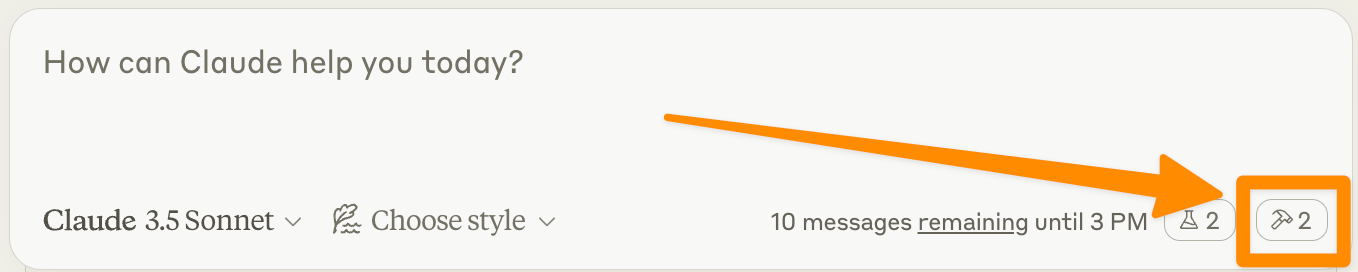 点击锤子图标后,您应该会看到列出的两个工具:
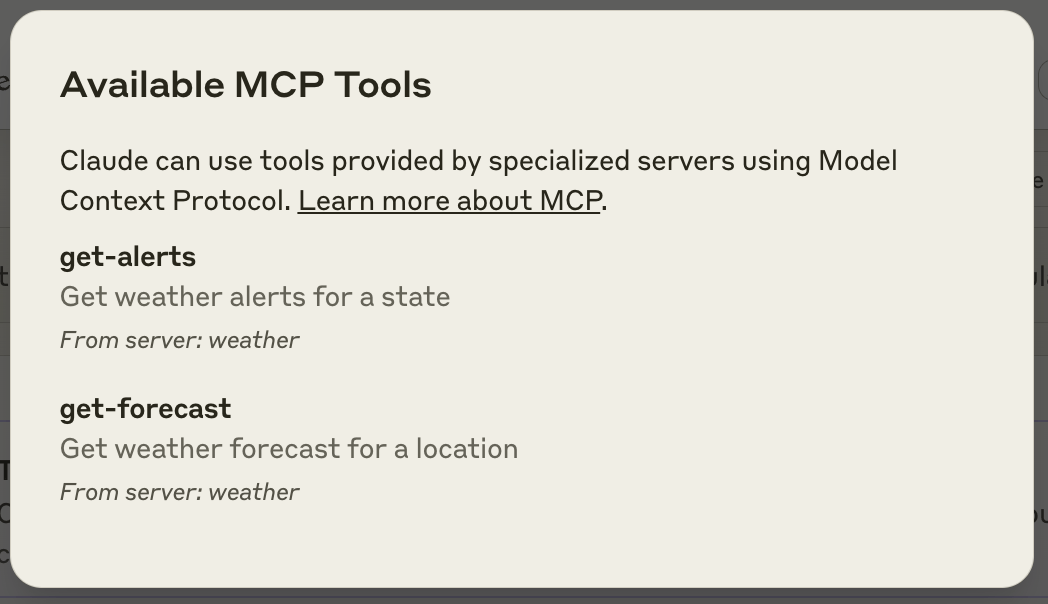 如果您的服务器未被 Claude for Desktop 拾取,请转到[故障排除](#troubleshooting)部分以获取调试提示。
如果锤子图标已显示,您现在可以通过在 Claude for Desktop 中运行以下命令来测试您的服务器:
* 萨克拉门托的天气怎么样?
* 德克萨斯州的活动天气警报是什么?
由于这是美国国家气象局,因此查询仅适用于美国位置。
## 背后的工作原理
当您提出问题时:
1. 客户端将您的问题发送给 Claude
2. Claude 分析可用工具并决定使用哪些工具
3. 客户端通过 MCP 服务器执行所选工具
4. 结果返回给 Claude
5. Claude 形成自然语言响应
6. 响应显示给您!
## 故障排除
**从 Claude for Desktop 获取日志**
与 MCP 相关的 Claude.app 日志记录写入 `~/Library/Logs/Claude` 中的日志文件:
* `mcp.log` 将包含有关 MCP 连接和连接失败的一般日志记录。
* 名为 `mcp-server-SERVERNAME.log` 的文件将包含来自命名服务器的错误(stderr)日志记录。
您可以运行以下命令以列出最近的日志并跟随任何新日志:
```bash theme={null}
# 检查 Claude 的日志中的错误
tail -n 20 -f ~/Library/Logs/Claude/mcp*.log
```
**服务器未显示在 Claude 中**
1. 检查您的 `claude_desktop_config.json` 文件语法
2. 确保项目路径是绝对路径而不是相对路径
3. 完全重新启动 Claude for Desktop
**工具调用静默失败**
如果 Claude 尝试使用工具但失败:
1. 检查 Claude 的日志中的错误
2. 验证您的服务器是否构建并运行没有错误
3. 尝试重新启动 Claude for Desktop
**这些都不起作用。我该怎么办?**
请参阅我们的[调试指南](/docs/tools/debugging)以获取更好的调试工具和更详细的指导。
**错误:无法检索网格点数据**
这通常意味着:
1. 坐标在美国之外
2. NWS API 有问题
3. 您被速率限制
修复:
* 验证您使用的是美国坐标
* 在请求之间添加小的延迟
* 检查 NWS API 状态页面
**错误:没有 \[STATE] 的活动警报**
这不是错误 - 这只是意味着该州目前没有天气警报。尝试不同的州或在严重天气期间检查。
有关更高级的故障排除,请查看我们的[调试 MCP](/docs/tools/debugging)指南
## 下一步
了解如何构建自己的 MCP 客户端以连接到您的服务器
查看我们的官方 MCP 服务器和实现的画廊
了解如何有效调试 MCP 服务器和集成
了解如何使用 LLM(如 Claude)加速您的 MCP 开发
如果您的服务器未被 Claude for Desktop 拾取,请转到[故障排除](#troubleshooting)部分以获取调试提示。
如果锤子图标已显示,您现在可以通过在 Claude for Desktop 中运行以下命令来测试您的服务器:
* 萨克拉门托的天气怎么样?
* 德克萨斯州的活动天气警报是什么?
由于这是美国国家气象局,因此查询仅适用于美国位置。
## 背后的工作原理
当您提出问题时:
1. 客户端将您的问题发送给 Claude
2. Claude 分析可用工具并决定使用哪些工具
3. 客户端通过 MCP 服务器执行所选工具
4. 结果返回给 Claude
5. Claude 形成自然语言响应
6. 响应显示给您!
## 故障排除
**从 Claude for Desktop 获取日志**
与 MCP 相关的 Claude.app 日志记录写入 `~/Library/Logs/Claude` 中的日志文件:
* `mcp.log` 将包含有关 MCP 连接和连接失败的一般日志记录。
* 名为 `mcp-server-SERVERNAME.log` 的文件将包含来自命名服务器的错误(stderr)日志记录。
您可以运行以下命令以列出最近的日志并跟随任何新日志:
```bash theme={null}
# 检查 Claude 的日志中的错误
tail -n 20 -f ~/Library/Logs/Claude/mcp*.log
```
**服务器未显示在 Claude 中**
1. 检查您的 `claude_desktop_config.json` 文件语法
2. 确保项目路径是绝对路径而不是相对路径
3. 完全重新启动 Claude for Desktop
**工具调用静默失败**
如果 Claude 尝试使用工具但失败:
1. 检查 Claude 的日志中的错误
2. 验证您的服务器是否构建并运行没有错误
3. 尝试重新启动 Claude for Desktop
**这些都不起作用。我该怎么办?**
请参阅我们的[调试指南](/docs/tools/debugging)以获取更好的调试工具和更详细的指导。
**错误:无法检索网格点数据**
这通常意味着:
1. 坐标在美国之外
2. NWS API 有问题
3. 您被速率限制
修复:
* 验证您使用的是美国坐标
* 在请求之间添加小的延迟
* 检查 NWS API 状态页面
**错误:没有 \[STATE] 的活动警报**
这不是错误 - 这只是意味着该州目前没有天气警报。尝试不同的州或在严重天气期间检查。
有关更高级的故障排除,请查看我们的[调试 MCP](/docs/tools/debugging)指南
## 下一步
了解如何构建自己的 MCP 客户端以连接到您的服务器
查看我们的官方 MCP 服务器和实现的画廊
了解如何有效调试 MCP 服务器和集成
了解如何使用 LLM(如 Claude)加速您的 MCP 开发